


NYC’s most recognizable city workers go by the monikers of finest, bravest, strongest and brightest. The NYPD, police department, New York’s finest, protects lives. The FDNY, Fire Department, New York’s bravest, saves lives. The DSNY Sanitation Department, New York’s strongest, keeps our streets clean. The NYCPS, New York City Public Schools, New York’s brightest, educates our children. Simple mottos with easily definable roles, occupations and responsibilities.
As a 27-year New York City Public School educator and 12-year principal, I’ve seen the lines blur constantly on how we define all the roles, responsibilities and services our New York City Public Schools provide while educating students. I acknowledge that the location, size, accessibility and functionality of schools make them ideal for multipurpose usages to serve the tax paying people. I’m not writing here to gripe about this, but notably to bring awareness and hopefully change the use of schools as sites for Early Voting, not one of our brightest and shining decisions. Allow me to explain.
For the record and to be clear, I am not against Early Voting, and vigorously participate in the NYCPS’s “Civics for All” initiative and “Civics Week – Student Voter Registration” campaigns we engage our students in annually. My school, Staten Island Technical High School, has been an Election Day Voting Site for as long as I can remember, even when I was a student at Staten Island Tech, my alma mater, in the late eighties and early nineties. Keeping in mind that by design, on Election Day every November, schools are closed for students, as the faculty and staff engage in Professional Development on-site, while voting takes place in our cafeteria. Clearly the combination of creating a day where students are home and the adults are the only ones in the building took into account sensible safety and security precautions for decades.
Since former NYC Mayor Bill DeBlasio announced the addition of Early Voting at 33 of NYC’s schools in the Fall of 2019, our school’s were initially promised minimal disruption to the school day, a guaranteed hot lunch for students, as well as additional staffing, NYPD officers, BOE monitors and custodial staff, as stated below:
“The Board of Elections designated 33 public schools for early voting citywide this year. The Administration is working across city agencies to ensure all 33 school sites are safe and secure, and there is minimal disruption to the school day. Schools will continue to serve free breakfast and lunch to all students every day, and the Department of Education (DOE) is guaranteeing a hot lunch throughout the early voting period.
DOE’s safety and facilities directors will visit each school every day, and every building will receive additional staffing including NYPD officers, BOE Monitors, and custodial staff. Information about each site has being sent home to families, and the DOE will remain in close contact with principals.”
Every single one of these promises has been broken and rarely, if ever fulfilled, five years later, as Early Voting in 2024 has ballooned into what will now be a 33-day occupancy of the 33 NYC Public Schools over three distinct voting cycles during the Spring and Fall of 2024, as outlined below:
I. 2024 NYS Presidential Primary Schedule – March / April (Impact: 11 Days)
- Early Voting Setup: Friday, March 22, 2024
- Early Voting: Sat Mar 23, 2024 to Sun Mar 31, 2024
- EV Breakdown / Primary Voting Setup: Monday, April 1, 2024
- Primary Voting: Tuesday, April 2, 2024
II. 2024 NYS Primary – June (Impact: 11 Days)
- Early Voting Setup: Friday, June 14, 2024
- Early Voting: Sat June 15, 2024 to Sun June 23, 2024
- EV Breakdown / Primary Voting Setup: Monday, June 24, 2024
- Primary Voting: Tuesday, June 25, 2024
III. 2024 NYS Elections – Election Day Oct/Nov (Impact: 11 Days)
- Early Voting Setup: Friday, Oct 25, 2024
- Early Voting: Sat Oct 26, 2024 to Sun Nov 2, 2024
- EV Breakdown / Primary Voting Setup: Monday, Nov 4, 2024
- Primary Voting: Tuesday, Nov 5, 2024
Total Impact: 33 Days
To break the issues down simply, what is common and a shared set of challenges among all of the 33 Early Voting NYC Public School sites is 5 major types of impact during each Early Voting Cyle, where Early Voting:
- disrupts hot meal service for up to 11 days.
- disrupts instructional and extracurricular school activities by eliminating use of school cafeterias, gymnasiums and libraries.
- poses major security risks allowing visitors with no ID into schools, and allows for shared use of common egress areas and restrooms.
- has no current protocols or procedures for building evacuations, lockdowns or shelter-in protocols.
- presents for 11 days a running gas-powered generator that is placed feet away from students to power the early voting equipment.
When Mayor DeBlasio and his administration originally identified the 33 NYC Public Schools, the borough of Queens felt strongly that schools should be left as schools and that bringing 9 extra days of voting into education environments would be a terrible decision. To this day, as of 2024, Queens remains the only borough that doesn’t use schools for Early Voting.
I can share a perspective as one of the principals of the NYC Public Schools impacted on the borough of Staten Island, where Staten Island Technical High School, Port Richmond High School and PS 8 – Shirlee Solomon serve as 3 of the 10 early voting sites in our borough. As is evident from the list below, there is precedence to use sites other than schools for Early Voting, as Community Centers and Houses of Worship were considered when compiling the list.
NYC Public Schools:
- PS 8 Shirlee Solomon (112 Lindenwood Road)
- Port Richmond High School (85 St Josephs Avenue)
- Staten Island Technical High School (485 Clawson St.)
Community Centers
- CYO Community Center (6541 Hylan Boulevard)
- Ocean Breeze Athletic Complex (625 Father Capodanno Boulevard)
- Central Family Life (59 Wright Street)
Houses of Worship
- Church of the Holy Child (4747 Amboy Road)
- Calvary Presbyterian Church (909 Castleton Avenue)
- Holy Family (366 Watchogue Road)
- Our Lady of Pity (1616 Richmond Avenue)
Let me break down and exemplify each of the five challenges Staten Island Technical High School and our neighboring public schools face when Early Voting occupies our buildings each voting cycle.
I. DISRUPTION OF HOT MEAL SERVICE DURING MORNING ENTRY & LUNCH
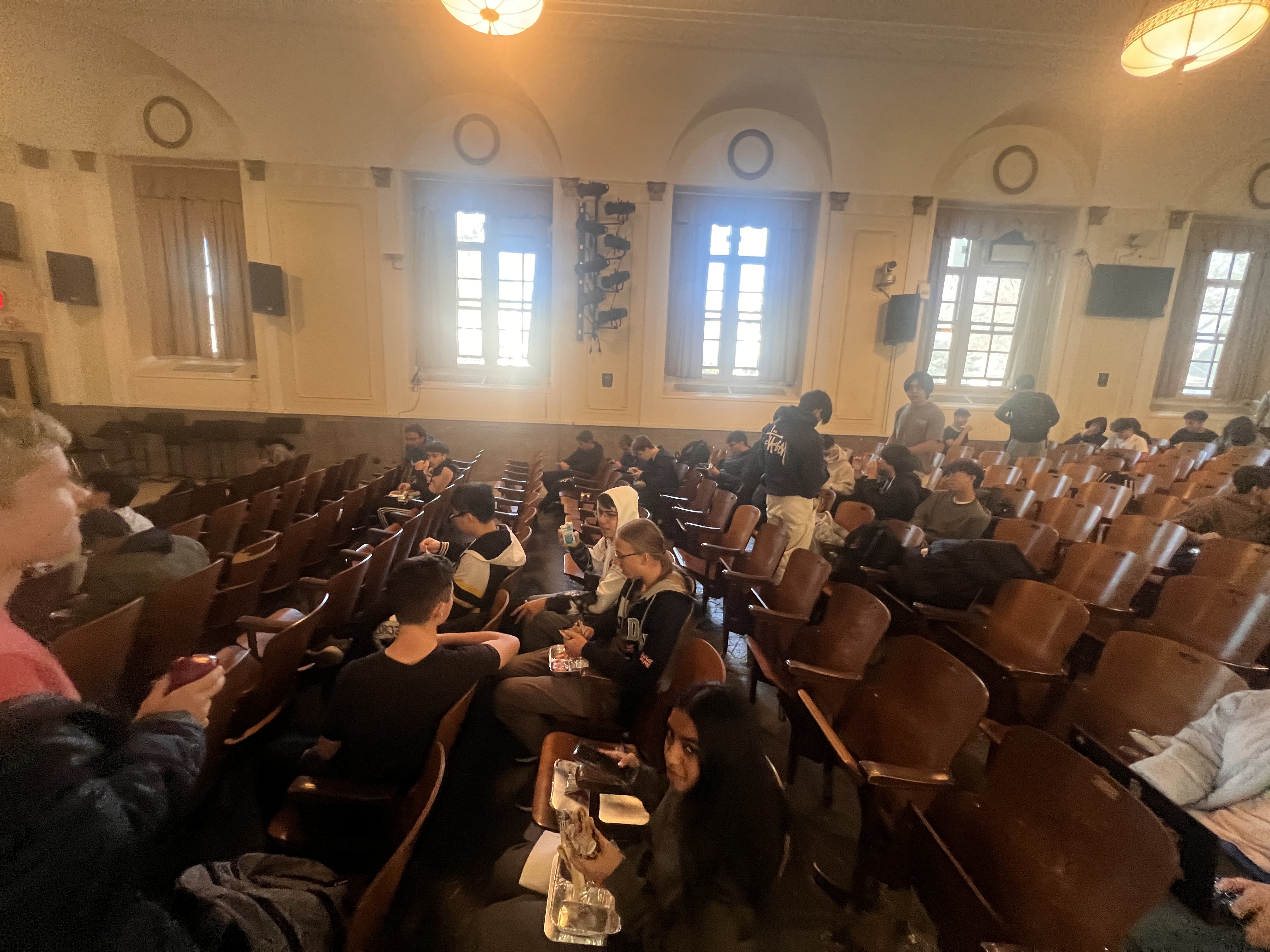
At Staten Island Tech, between 45-50% of our families represent our most vulnerable students whose economic circumstances leave them depending on school as their only source for a hot meal each day. Mayor De Blasio’s promise for hot lunch service went unfulfilled for the first 3 years of early voting at our school. From 2019 until 2022, cold bagged breakfast and lunch was our students’ only option. It took many discussions and pleading back and forth with the NYC Board of Elections team to allow for a modified access to the cafeteria during Early Voting to temporarily allow students to gain access to a hot meal. Students travel each early voting day from the cafeteria during lunch to pick up a hot meal, and then travel to the other end of the building ( a 4-minute walk) where our auditorium is located. However, there are no table surfaces in the auditorium as students have to juggle their belongings and a meal tray on their lap.
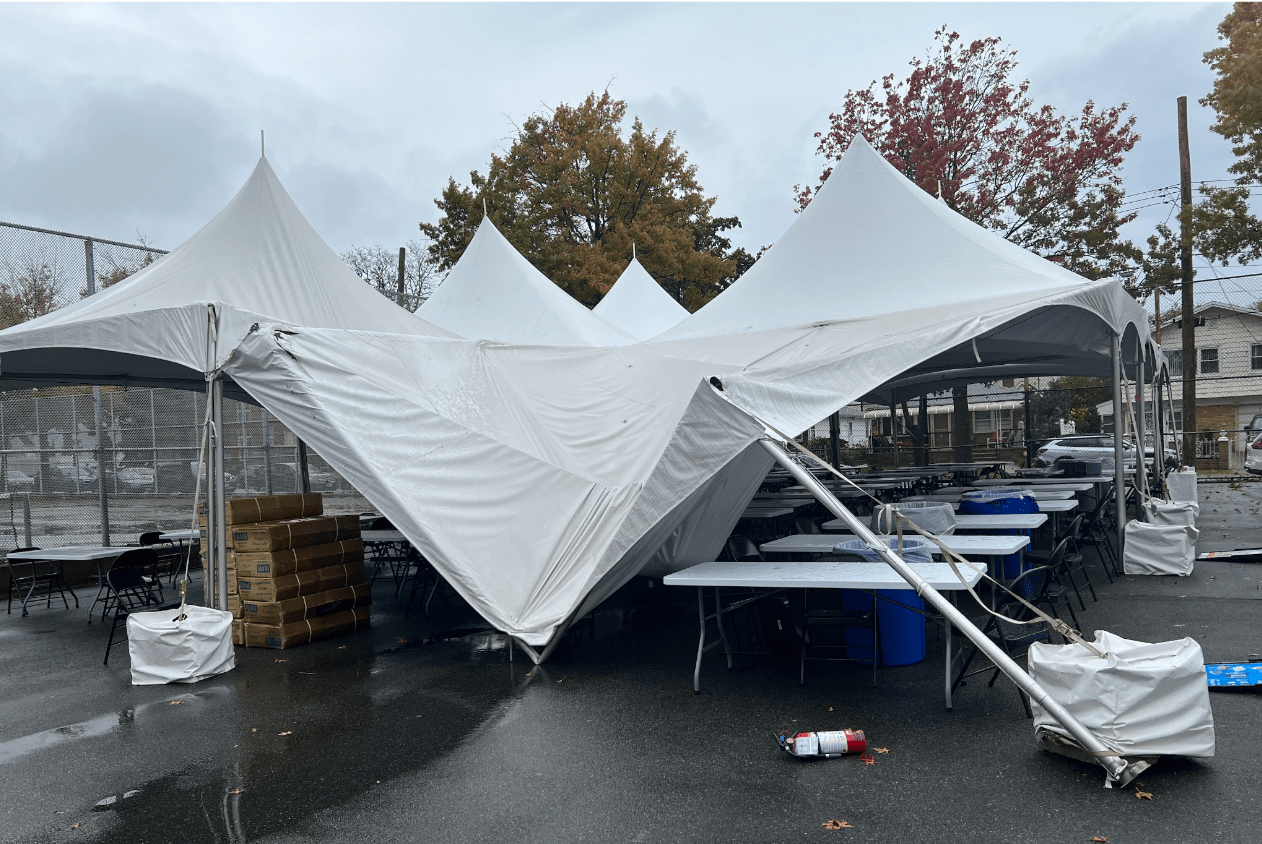
As a temporary remedy to the breakfast and lunch issue, in October of 2021 Staten Island Tech (and other schools) were provided with an outdoor tent for students, with seating and tables during the frigid October and November voting days. The night before Early Voting began, a Nor’easter made its way through New York City and the tent collapsed under the strong winds and rainfall, rendering the tent unsafe and uninhabitable. Needless to say since, we continue to use the auditorium, while not an ideal remedy, it proves to be a safer solution to moving students outdoors during potential inclement weather.
Port Richmond High School has yet to be provided with a suitable solution. After 5 years students still go without access to a hot meal for 11 days each early voting cycle. Their students and principal, Andrew Greenfield, share their experience during a recent edition of Port Richmond’s Newszine, Good Morning Port Richmond.
II. DISRUPTION OF INSTRUCTIONAL AND EXTRACURRICULAR ACTIVITIES
Our cafeteria serves a multitude of purposes throughout each school day and especially after school and during the weekends. At the start of the day the cafeteria is a staging area where students enter the building, eat breakfast, hang out with friends, complete school work or study until the start of their first instructional period. Our cafeteria is an optimal setting to effectively, efficiently, safely and securely welcome the 1407-student body who travel from the five boroughs of New York City daily during periods 0, 1 and 2.
In between our four lunch periods, which starts at 10:21 AM and ends at 1:17 PM, we also utilize the cafeteria for our Table Tennis Physical Education classes. During Early Voting, we must suspend the use of the cafeteria for Physical Education instructional activities, which in 2024 will include 21 instructional days of the total 33 early voting days. 21 days encompass 12% of the 180 total instructional days that are mandated by the NYS Education Department.
After the final lunch period of the day, the cafeteria is utilized periods 8 and 9 by students who have free time to complete school and homework assignments prior to the beginning of extracurricular activities. The cafeteria is the only space in the building where 400 or more students can fit to safely and effectively conduct their work on tabled surfaces and have opportunities to socialize without having to be forced to leave the building until extracurricular activities begin. Some of these extracurricular activities are conducted in the cafeteria as well, since it is large enough to accommodate numerous clubs and PSAL practices and games simultaneously for our Table Tennis and Fencing teams. In addition, the cafeteria space is used during the weekends for practices and competitions, being the building is operating 7-days a week.
III. SECURITY RISKS AND BUILDING ENTRY PROTOCOLS
As of 2024 it is becoming a common practice for schools to lock their front doors and use installed bells and security cameras to screen, identify and approve visitor entry. It’s ironic that in these same schools where Early Voting exists, through the separate early voting entry, no identification is needed, no scrutiny or screening is employed and one can only hope that the “voter’s” true intention is to actually vote. The potential for risk is apparent and real. This very issue has presented itself at Staten Island Tech where Board of Election staff and early voters use the restroom facilities and then decide to take an unapproved / unguided tour throughout the building. On countless occasions this scenario has put our school within moments of a lockdown or search for an intruder in the building, which in modern times is terrifying and an all-too real scenario that has ended with tragic circumstances.
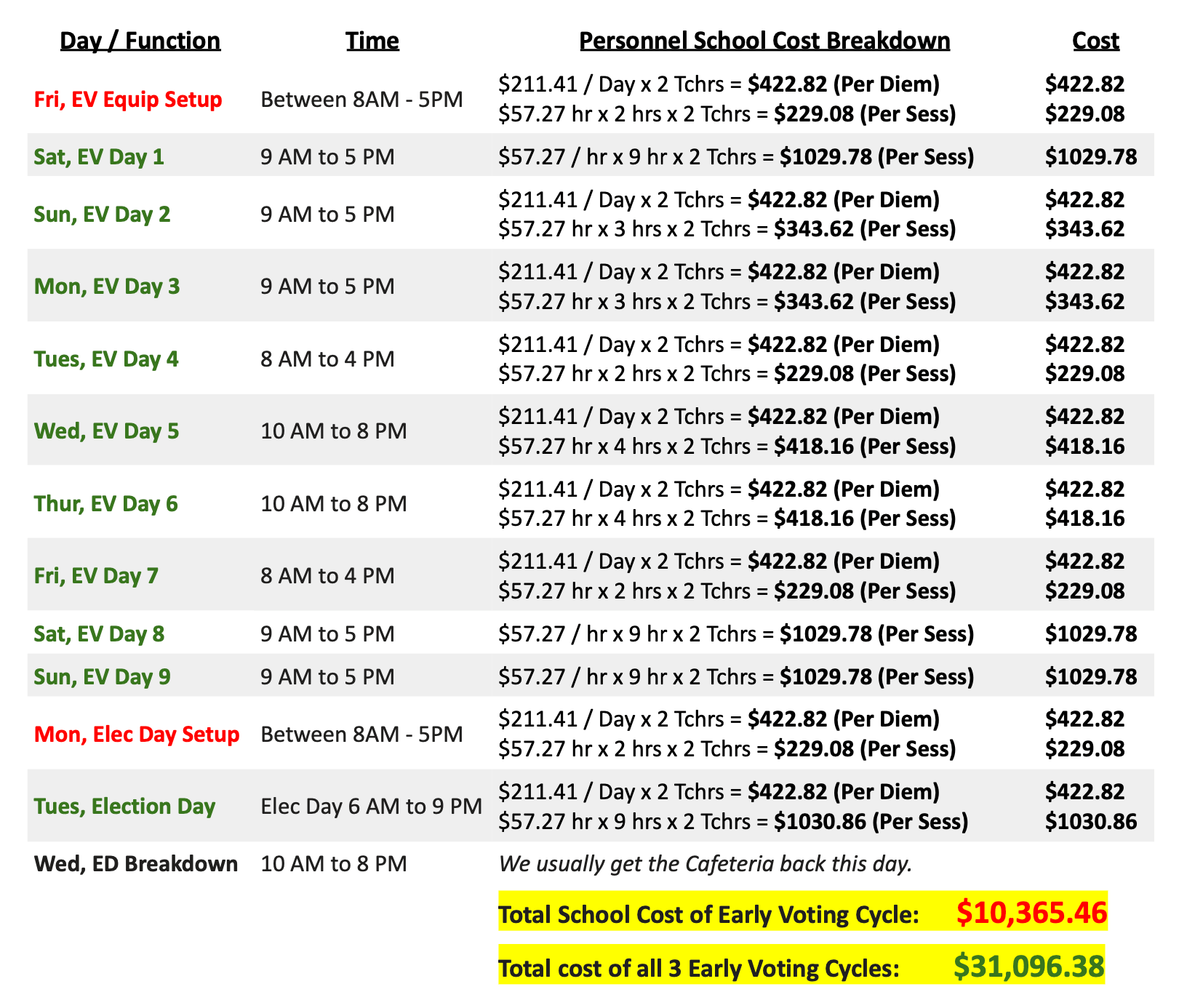
The issue with preventing this occurrence reverts back to the unfulfilled promise of extra security personnel and staff to assist our school with hosting early voting. On only a few occasions during the first year of Early Voting was extra School Safety Agents provided to Staten Island Tech and other schools as a support. Since 2020 there has been no extra deployment of School Safety Agents or extra NYPD police officers. In order to properly secure the threshold that adjoins the Early Voting Cafeteria and the active area where students occupy our school, I as the principal must hire additional personnel. In total, two extra substitute teachers must be hired each day out of the tax-levy budget to supervise the threshold and to escort Board of Election staff and early voters to and from the restrooms, ensuring there is a safe and appropriate interaction between workers, voters, students, faculty and staff. There is no supplemental budget line provided to Early Voting Schools to cover the additional expenditure this costs each of our schools. For the upcoming election cycles in 2024, the following budget schedule will be required in order to properly secure the utilization of our building during Early Voting:
Unfortunately, at PS 8 – Shirlee Solomon elementary school, faculty member, teacher Dennis Modaferri recounts his negative altercation with an Early Voter and Board of Election staff who became belligerent, uncooperative and borderline violent during the Fall 2023 Early Voting cycle:
IV. SCHOOL GENERAL RESPONSE PROTOCOL (EVACUATION, SHELTER-IN, LOCKDOWN) PROTOCOLS
Schools train and drill all staff and students in the General Response Protocol, which describes what to do in an Evacuation, Shelter-In, or Lockdown. The training is tailored for different grade levels so that students are able to properly and safely respond to each scenario properly. Since Early Voting’s inclusion in school settings since 2019 no discussion, training or mention of General Response Protocols has occurred to ensure that all Board of Election staff and early voters respond safely and correctly in the event of an emergency.
While it is my understanding that I as the principal of the school make the final decision when our school must enter a General Response Protocol, I would like to get further clarification and assurance that all BOE staff are aware and will cooperate. As of this writing, I still have not received any guidance from the Board of Elections regarding this urgent matter.
V. INSUFFICIENT POWER GRID IN SCHOOLS / 24-HOUR 11-DAY GAS POWERED GENERATOR SOLUTION
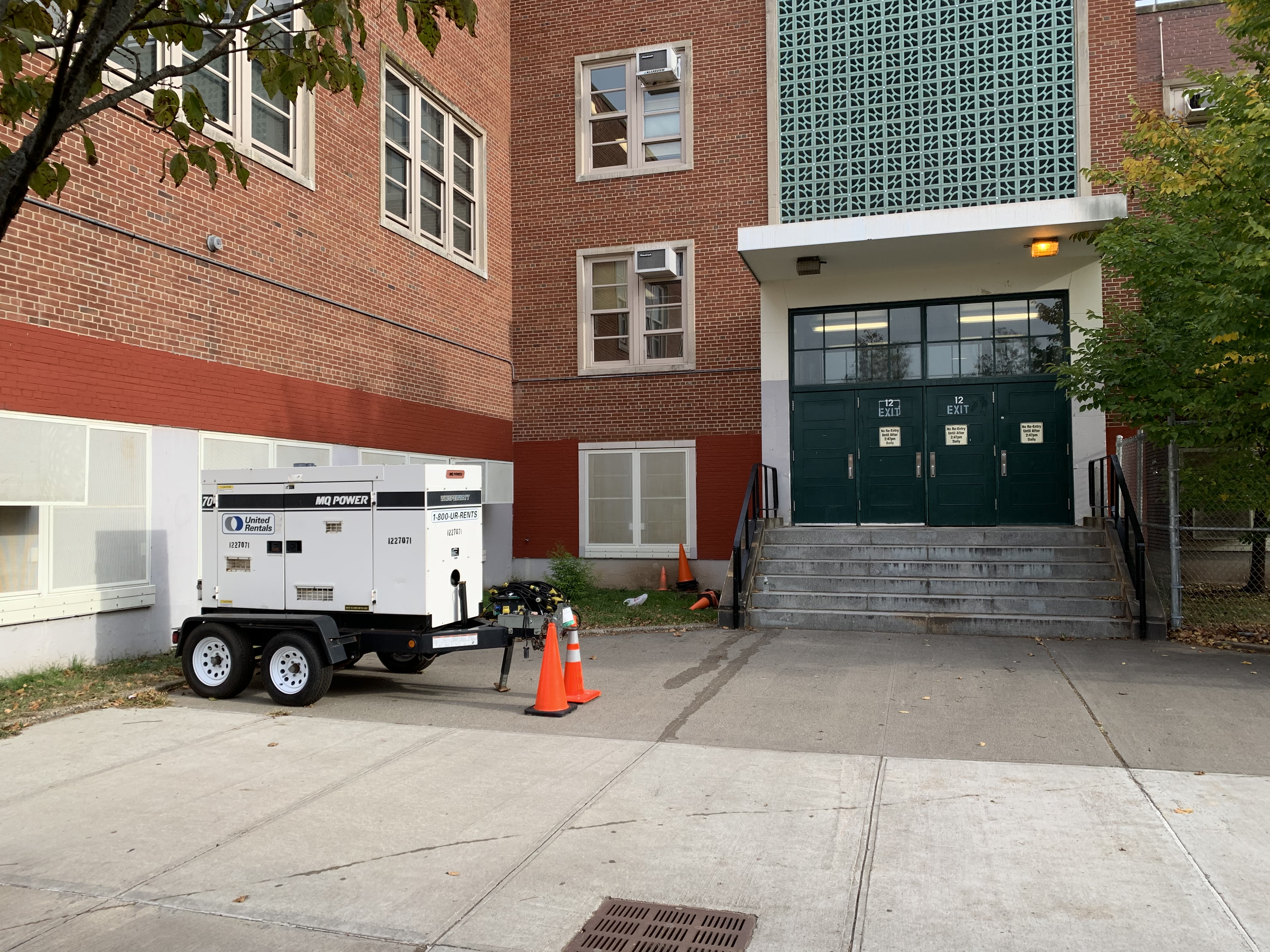
The last issue I’ll end with is actually where Early Voting starts, when a massive gas-powered generator arrives the week before Early Voting commences, installed within feet of student access. The generator runs 24-hours for 11-days, powering all voting equipment, since our school’s electrical grid is insufficient. Repeatedly, panicked students reported “smoke and noxious fumes throughout the building” where we came within seconds from evacuating the school before realizing the source of the smoke and smell.
What is most puzzling to me is that despite the fact that school’s electrical systems are insufficient to run the Early Voting equipment, that wasn’t enough of a reason to rethink using schools in the first place. The best solution that professionals, adults, leaders in-fact under the direction of the Board of Elections was to place a 24-hour running gas-powered generator within feet of children on school grounds?
A GRASSROOTS MOVEMENT – CITYWIDE COUNCIL OF HIGH SCHOOLS RESOLUTION
In the absence of support and a response from respective NYC agencies regarding the 33 principal’s concerns around the impact of Early Voting in our schools, the 3 schools on Staten Island have worked closely with the Citywide Council on High Schools for support.
The Citywide Council on High Schools (CCHS) is a dedicated group of volunteer parents that advocate on behalf of all NYC public high school students. The CCHS welcomes parents, school leadership groups and students to express their concerns and comments, as their mission is to help ensure the richest educational experience possible for our children.
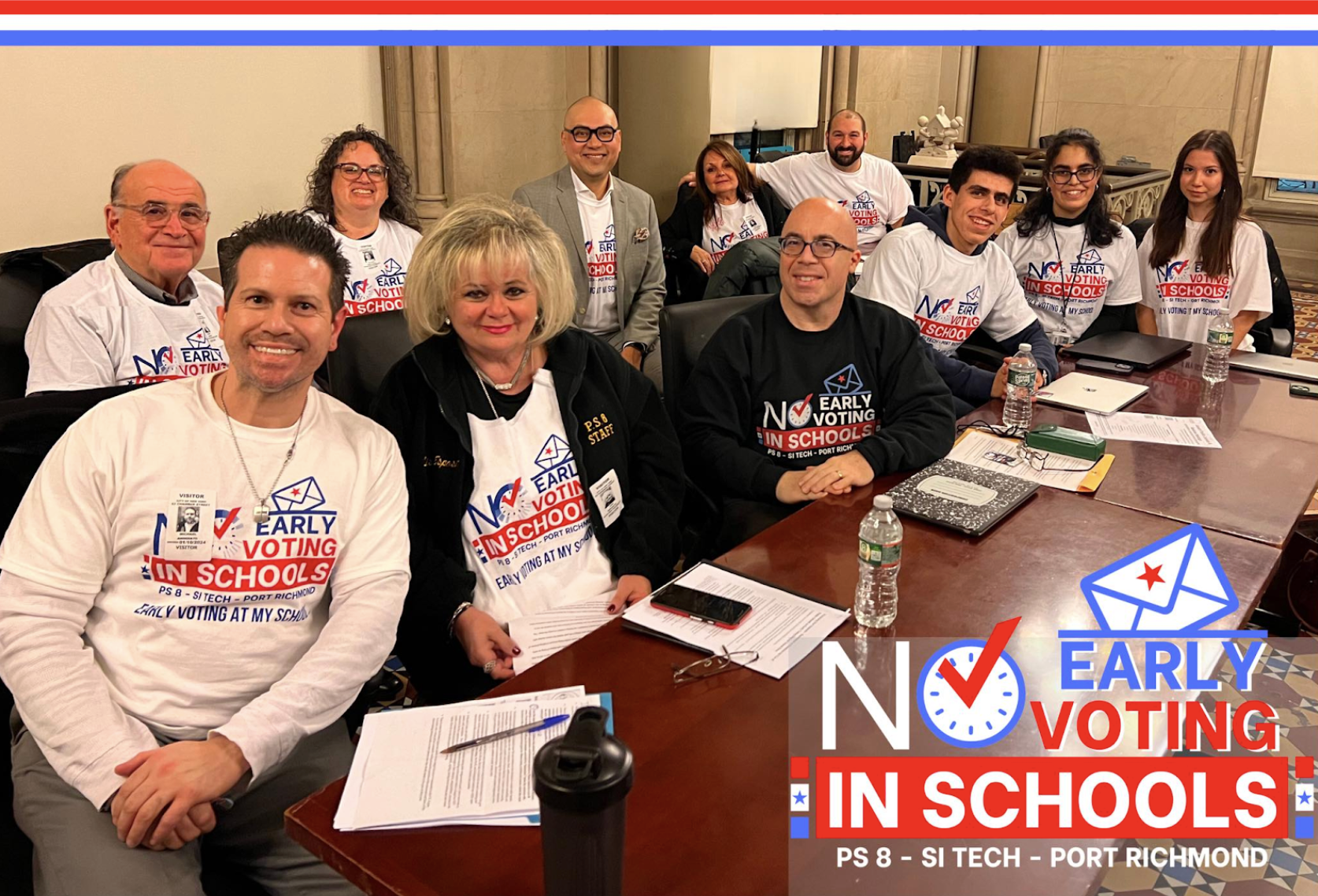
On January 10, 2024, students, parents & faculty from Staten Island Tech, Port Richmond High School & PS 8 – Shirlee Solomon, provided public commentary at the January Citywide Council on High Schools (CCHS) meeting at the Tweed Courthouse in NYC. On January 10th a resolution was introduced to remove Early Voting from NYC Public Schools, which was unanimously passed by the CCHS and will now be presented to the NYC Department of Education for commentary.You can check out out the video (https://bit.ly/cchsEVresolution) and our school community public comments from the January 10, 2024 CCHS meeting, as well as read about the coverage in the Daily News bit.ly/nydnEVarticle.
UFT DELEGATE ASSEMBLY RESOLUTION
In similar news to the Citywide Council on High Schools meeting, the United Federation of Teachers conducted a delegates meeting in January, to vote on a UFT resolution (https://bit.ly/uftEVreso) calling for the union to press the city Board of Elections to refrain from using public schools as early voting sites. Nicholas Macula, a UFT delegate from Staten Island Technical High School, motivated the resolution. He said schools were deprived of their cafeteria or their gymnasium on early voting days, while the presence of poll workers and voters in the same building as students presented safety concerns. “We are not anti-early voting,” he said. “Early voting is an extension of the franchise. But schools do not seem to be the ideal location.” The delegates overwhelmingly voted to approve the resolution.

ENGAGING WITH THE BOARD OF ELECTIONS
It is February 19, 2024 and I’ve made three attempts to engage in a conversation with the Board of Elections leadership to discuss some of the issues above in addition to suggesting alternative solutions. I’ve received no response with the exception of the same ridiculous request for “me” to come up with and suggest alternative Early Voting Sites on Staten Island. I thought my job as a principal was to run Staten Island Technical High School? Now the Board of Elections has requested me to do “their” job!
Ok then, here you go NYC Board of Elections leadership team. I am ready and prepared for such a conversation. I mapped the current Early Voting sites on Staten Island and researched what NYC owned properties and buildings nearby have ADA accessibility, proximity to public transportation and parking. I was able to find 3-4 alternative sites that are viable near Staten Island Technical High School, Port Richmond High School and PS 8 – Shirlee Solomon. I am positive there are other viable options, such as Houses of Worship or Community Centers that would be willing to host Early Voting if you’d care to assist in reaching out for inquiries on the 3 NYC Public school’s behalf.
It is February 19, 2024 and I’ve made three attempts to engage in a conversation with the Board of Elections leadership to discuss some of the issues above in addition to suggesting alternative solutions. I’ve received no response with the exception of the same ridiculous request for “me” to come up with and suggest alternative Early Voting Sites on Staten Island. I thought my job as a principal was to run Staten Island Technical High School? Now the Board of Elections has requested me to do “their” job!
Ok then, here you go NYC Board of Elections leadership team. I am ready and prepared for such a conversation. I mapped the current Early Voting sites on Staten Island and researched what NYC owned properties and buildings nearby have ADA accessibility, proximity to public transportation and parking. I was able to find 3-4 alternative sites per school, that are viable near Staten Island Technical High School, Port Richmond High School and PS 8 – Shirlee Solomon. I am positive there are other viable options, such as Houses of Worship or Community Centers that would be willing to host Early Voting if you’d care to assist in reaching out for inquiries on the 3 NYC Public school’s behalf.

I’ll conclude with this map above and a hope that someone out there at the New York City Board of Elections and New York City Mayor’s Office is listening to yet another plea for a sensible solution. The silence is astounding, unprofessional and the clock is ticking with the calendar days moving closer to what will be 33-days of what is going to be the most polarizing presidential election in modern history.
Are our student’s safety and education worth the risk and are the leaders who can make the difference willing to make the time to eliminate or minimize the challenges that remain on the shoulders of 33 principals who are pleading for support? Or does some unfortunate tragedy need to occur before action takes place?
Learn more and support our cause at: https://www.noearlyvotingatschools.com/
Thank you!
 MarkErlenwein.com