

Childhood Is Not an Open Border Policy
By Mark Erlenwein
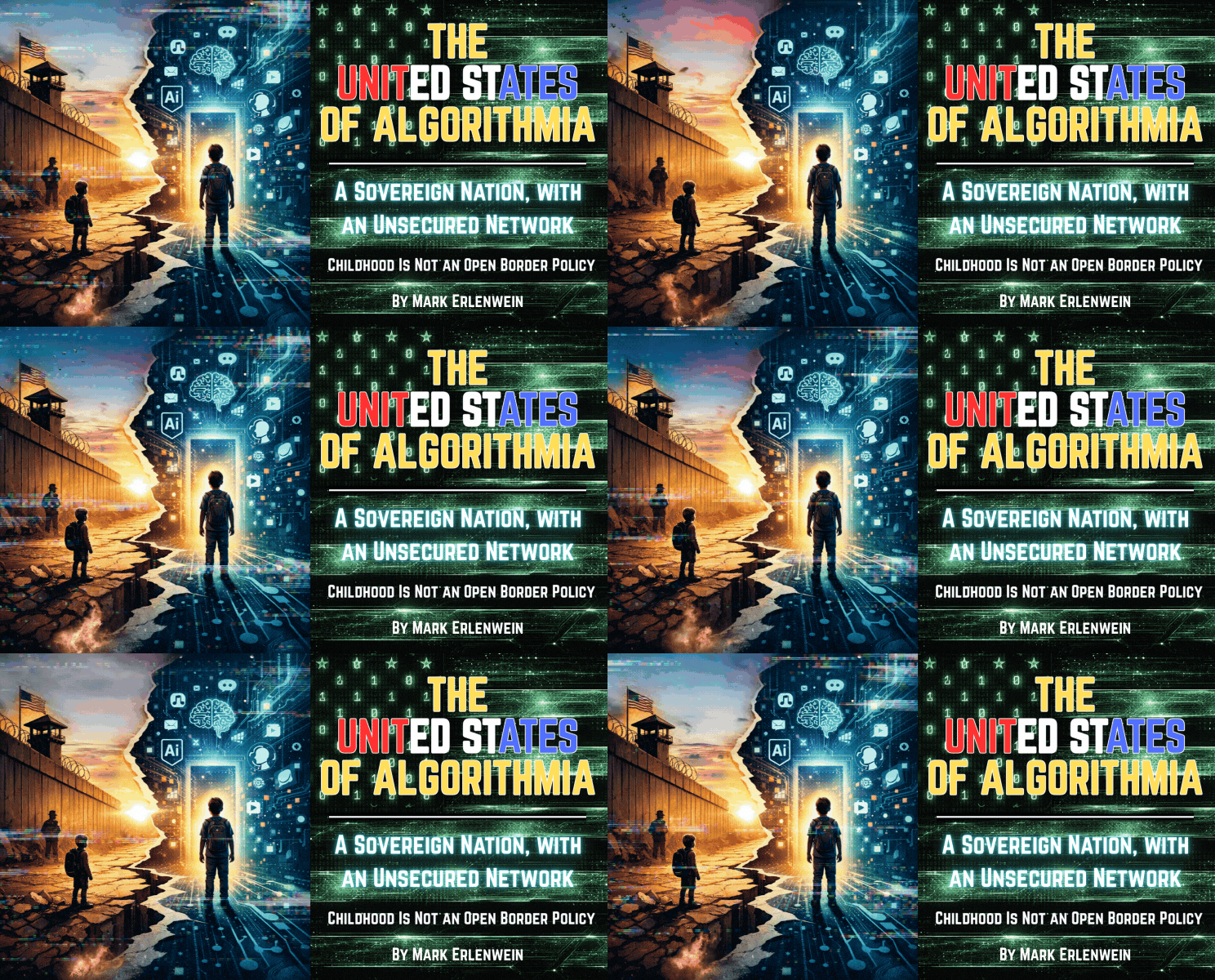
Childhood Is Not an Open Border Policy
There is something deeply American about our obsession with borders.
We debate them endlessly.
We campaign on them.
We fund them.
We argue about who crosses them.
But while we fight over geography, we have quietly surrendered the only border that actually shapes the daily lives of our children:
The digital one.
And if you spend your days inside a high school like I do, you can feel it.
Not hypothetically.
Not politically.
Tangibly.
The (Anxious) Generation We Accidentally Designed
When Jonathan Haidt published The Anxious Generation, it did not read like cultural nostalgia. It read like an indictment backed by longitudinal data.
Beginning around 2010 to 2012, the moment smartphones and social media became dominant in adolescent life, mental health indicators shifted dramatically.
According to CDC Youth Risk Behavior Surveillance data:
- Between 2011 and 2021, persistent feelings of sadness or hopelessness among U.S. high school girls increased from 36 percent to 57 percent.[1]
- Suicide rates for girls aged 10 to 14 rose by 167 percent between 2009 and 2019.[2]
- Emergency room visits for self harm among adolescent girls nearly tripled between 2010 and 2020.[3]
Haidt argues that we replaced a “play-based childhood” with a “phone-based childhood,” and the social experiment was conducted without guardrails. [4]
Here is the uncomfortable truth:
We did not stumble into this, we engineered it! And I’m not 100% certain at times that this (lack of governmental oversight) wasn’t by design.
#control #obey
Platforms optimized for engagement.
Engagement optimized for profit.
Profit optimized for attention capture.
And how did we verify whether children were legally allowed on these platforms?
Click: “I am 13.”
That was the border security system.
Now We Are Doing It Again
Enter artificial intelligence.
I am not anti AI. Quite the opposite. I speak about it, nationally. I use it. I believe it can amplify human centered learning and productivity when deployed responsibly.
But I also see the pattern of we as a country releasing generative systems capable of:
- Producing photo and videorealistic deepfakes
- Simulating authority figures
- Offering mental health advice
- Generating persuasive content at scale
And there is still no standardized, federally implemented digital age verification infrastructure in place. The opposite is playing out in real time, quicker than ChatGPT’s 5.2 Instant answer model can generate.
As of early 2026, the strongest pushback against comprehensive AI regulation is not coming from Silicon Valley alone, but from Washington. The dominant federal stance favors a “light touch” approach, warning that state-level safeguards would create a messy “patchwork” of laws that could weaken U.S. competitiveness. The fear, it seems, is not that we are moving too fast without guardrails, but that someone might actually install them, at the detriment of our youngest generation of learners.
Common Sense Media reported in 2023 that 62 percent of U.S. teens use AI tools, often for academic and social purposes.[5] Usage is climbing fast.
At the same time, the National Institute of Standards and Technology has acknowledged that reliable online age verification remains fragmented and inconsistent across platforms.[6]
The translation is, that we are once again placing world altering technology directly into adolescent ecosystems without a certified perimeter.
The Immigration Irony
We mobilize billions of dollars toward physical border enforcement.
Don’t fret, I’m not going there, but … In fiscal year 2023 alone, U.S. Customs and Border Protection operated on a budget exceeding 17 billion dollars. [7]
We debate asylum policy in prime time.
We analyze fence footage in high definition.
Meanwhile, there is no universal digital identity system that reliably distinguishes a 12 year old from a 32 year old online.
No federally standardized certification layer for AI access.
No coherent developmental tiers for immersive digital systems.
We protect geography.
We ignore psychology.
The real sovereignty crisis is not at the Rio Grande.
It is inside the cognitive landscape of adolescence.
What a Digital Border Would Actually Mean
This is not a call for surveillance dystopia, it is a call for developmental alignment.
We already regulate:
- Driving licenses by age
- Alcohol purchases by ID
- Voting through identity verification
- Banking through multi factor authentication
But when it comes to AI companions, algorithmic feeds, and generative systems capable of emotional simulation? We shrug.
A serious national conversation would include:
- Privacy preserving digital age certification infrastructure
- Tiered AI access standards based on developmental research
- School aligned digital ID integration
- Clear federal guidelines for AI systems interacting with minors
Innovation should not outrun infrastructure, nor short circuit our children’s development.
Yet it keeps doing exactly that.
The Cost of Not Building the Border
The research is not abstract (being the research data is practically boiler plate in present times).
The American Psychological Association reported in 2023 that 46 percent of teens say social media makes them feel worse about their body image. [8]
The U.S. Surgeon General issued an advisory warning that social media poses a “profound risk of harm” to youth mental health without stronger safety standards. [9]
If that was the aftermath of the smartphone era, what happens when generative AI scales across every feed, every classroom, every social channel?
We cannot claim ignorance this time.
We have data.
We have research.
We have lived experience (and policies) inside schools.
We simply lack political will.
A Principal’s View
Inside my building, I see brilliance every day. I see resilience. I see ambition.
I also see attention fragmentation in real time.
I see students toggling between five cognitive streams before lunch.
I see teachers competing with devices engineered by some of the most sophisticated behavioral scientists on the planet.
And I ask myself, “Why are we as a nation so disciplined about physical borders and so reckless about digital ones?”
The debate should not be immigration versus innovation.
It should be innovation with infrastructure.
Because childhood is not an open beta test, nor should remain an open border.
The Question We Should Be Asking
In the wealthiest and most technologically advanced country in the world, how is it possible that we still rely on self reported age checkboxes to regulate access to the most psychologically immersive technologies ever built?
If we fail to establish digital borders now, Jonathan Haidt will be writing the sequel titled, The Artificial Generation: When Artificial Intelligence Rewired Adolescent Development, in less than a decade.
And this time, the accelerant will not just be social media.
It will be artificial intelligence.
And we will not be able to say we did not see it coming.
Notes & Sources
[1] Centers for Disease Control and Prevention, Youth Risk Behavior Survey Data Summary and Trends Report, 2011 to 2021.
[2] National Center for Health Statistics, Suicide Rates for Females Aged 10 to 14, 2009 to 2019.
[3] Centers for Disease Control and Prevention, National Syndromic Surveillance Program data on self harm emergency visits, 2010 to 2020.
[4] Haidt, Jonathan. The Anxious Generation. Penguin Press, 2024.
[5] Common Sense Media, “Teens and AI: 2023 Report.”
[6] National Institute of Standards and Technology, Digital Identity Guidelines and Age Assurance Discussions, 2023.
[7] U.S. Customs and Border Protection, Fiscal Year 2023 Budget Overview.
[8] American Psychological Association, “Health Advisory on Social Media Use in Adolescence,” 2023.
[9] U.S. Surgeon General, “Social Media and Youth Mental Health Advisory,” 2023.
 MarkErlenwein.com