

A serious national plan and blueprint for age certification, developmental guardrails, and AI that strengthens (not short-circuits) learning
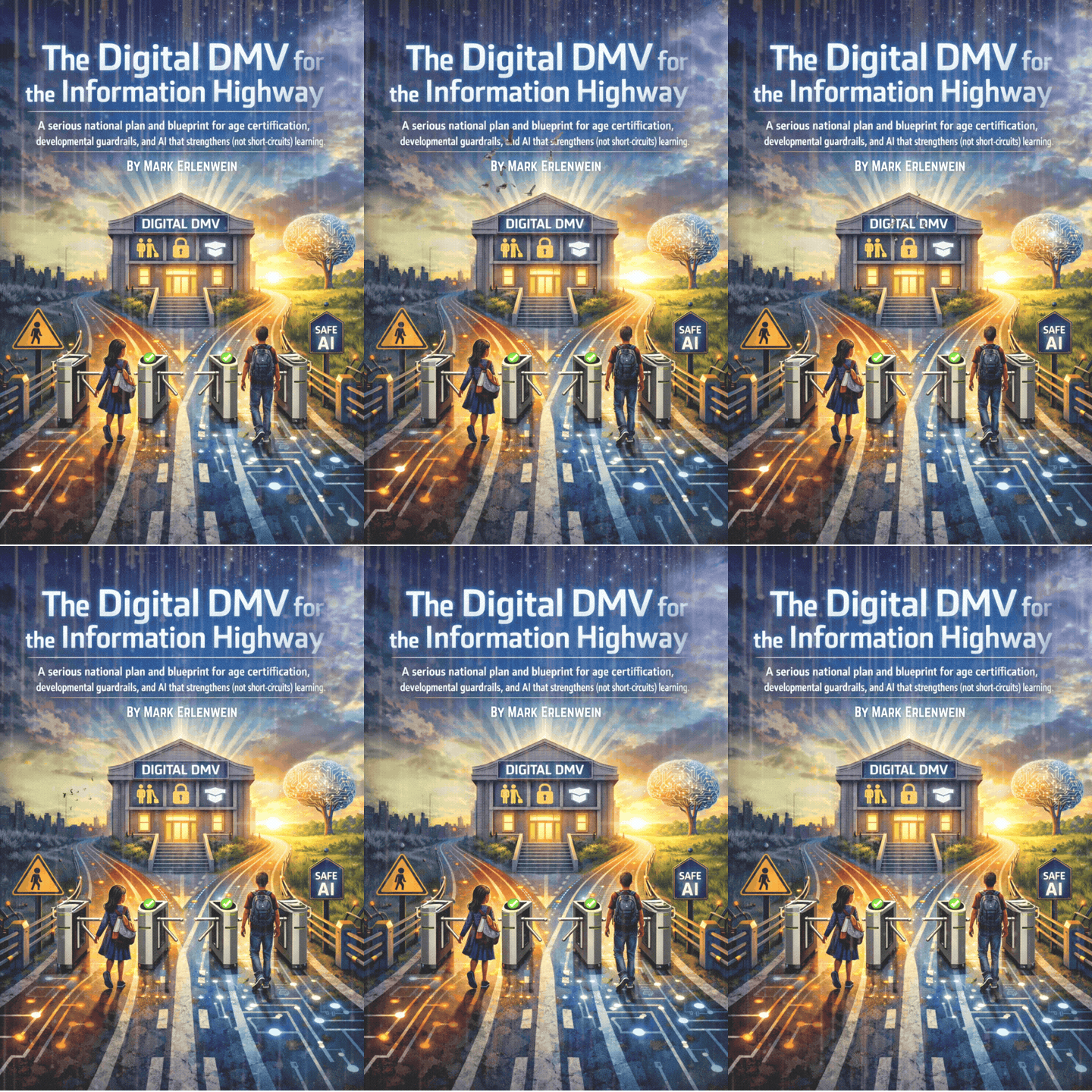
In my last article, The United States of Algorithmia – A Sovereign Nation, with an Unsecured Network, I raised the alarm! We’re a nation obsessed with physical borders while leaving the digital ones wide open, and our kids are the ones crossing that terrain unsupervised. But awareness without action is just anxiety with better vocabulary. So this follow-up is the pivot from critique to construction. If the first piece was the warning sign on the information highway, this one is the blueprint for building the on-ramps, guardrails, and licensing system we should have installed years ago. What follows is a practical, privacy-preserving plan for a “Digital DMV” that verifies age without harvesting identity, sets developmentally tiered access lanes, connects school to home, and gives government and AI companies clear standards for how minors interact with the most powerful tools we’ve ever placed in their hands.
Thanks for reading,
Mark Erlenwein, NYC Public School Principal – Lifelong EdTechnologist
We built highways because movement matters.
But we didn’t just pave asphalt and call it a day. We designed an entire ecosystem around the fact that roads are powerful, shared, and dangerous when misused:
- training
- licenses
- speed limits
- seatbelts
- traffic lights
- enforcement
- consequences
Now zoom out.
Our children travel far more miles each day on digital highways than physical ones. They commute through feeds, platforms, group chats, games, AI tools, and infinite-scroll side streets where the exit signs are engineered to disappear.
And our national system for “who is allowed where” is still basically:
“Click here to confirm you’re 13.”
That’s not a policy. That’s a punchline.
If we are going to have an honest national conversation, it has to start with a simple premise:
Digital pathways shared with children require governance that is at least as serious as the governance we demand on physical roads.
Not because we hate innovation. Because we love childhood.
1) Establish a privacy-preserving digital age certification infrastructure
Let’s say this clearly, because the moment you bring up age verification someone yells “surveillance!” and sprints out of the room.
This is not about building a national creep-machine.
This is about building a privacy-preserving age certification system that works like this:
- A trusted verifier confirms age once (through an approved method).
- The user receives an age credential (not a public profile, not a data dump).
- Platforms receive only what they need: age tier confirmation, not personal details.
Think “digital wristband at a venue,” not “government following you around the mall.”
What this system should and should not do
It should:
- Confirm age tier (Under 13, 13–15, 16–17, 18+)
- Allow parental consent where required
- Be interoperable across major platforms and devices
- Be auditable, secure, and hard to spoof
It should not:
- Create a centralized database of children’s browsing
- Force platforms to store sensitive identity documents
- Become another data extraction tool disguised as “safety”
In other words: verify age without harvesting identity.
If we can secure banking, passports, and tax filing, we can build a digital gate that doesn’t double as a data vacuum.
2) Create age-tiered access standards based on developmental research
Right now, our tech world treats childhood like one long continuous adulthood with training wheels.
But adolescence is not a single stage. It’s a sequence of developmental construction zones. Executive function, impulse control, identity formation, critical thinking, social cognition, and attention regulation develop over time. Tools should reflect that.
So instead of “allowed vs. not allowed,” we need age-tiered standards that answer:
- What is appropriate at 10?
- What is appropriate at 13?
- What is appropriate at 16?
- What requires adult status?
A practical model: “Digital Access Lanes”
Think of it like lanes on a highway:
- Lane A (Under 13): highly restricted, minimal algorithmic exposure, strong defaults, parent-controlled permissions.
- Lane B (13–15): limited social features, limited personalization, strict AI boundaries on persuasion, intimacy, and self-harm content.
- Lane C (16–17): broader access with guardrails, transparency, and education-first constraints.
- Lane D (18+): full access with informed consent, accountability, and clear recourse.
This isn’t about infantilizing teens. It’s about aligning access with development and admitting the obvious: a platform optimized for adults is not automatically safe for minors just because minors can operate it.
Kids can also operate a forklift. Still not a great idea.
3) Require parental consent where needed, without making parents the full-time compliance department
Parents matter. Families matter. But we cannot outsource a national failure of governance to individual households like it’s a DIY bookshelf.
A workable system would include:
- Clear permission flows for under-13 and sensitive features for older tiers
- Parent dashboards that are usable (not “designed by an engineer at 2 a.m.”)
- Default “safe settings,” not optional “safety features”
- A consent model that is consistent across platforms (not 400 different settings pages)
Parents should not have to earn a minor in cybersecurity to raise a child.
4) Integrate “school-aligned digital ID” from school to home to the real world
This is the missing link.
Schools are where child development is most consistently observed. Schools are where we already manage identities, schedules, access, and accountability. But the moment a student leaves the building, the digital world becomes the Wild West.
We need a school-aligned digital ID integration that connects safety across contexts:
- Student identity and age tier recognized across educational tools
- Protections that travel from school device to home device
- Clear separation between educational credentialing and surveillance
- Guardrails that extend beyond the classroom without turning schools into police
This is not about schools controlling students at home. It’s about ensuring the safeguards don’t disappear at 3:01 p.m.
If we can align health requirements, attendance, transcripts, and transportation, we can align developmental protections.
5) Establish clear federal guidelines for AI systems interacting with minors
This is the “you can’t just wing it” moment.
We need federal guidelines that set the floor, not the ceiling, on what AI companies can do when minors are involved.
Not vague “best practices.” Actual requirements.
What guidelines should cover
- Age-aware functionality: the tool behaves differently depending on verified age tier
- Prohibited interactions: no simulated romance, coercion, grooming patterns, or manipulative intimacy with minors
- Academic integrity modes: AI that supports learning without replacing it
- Transparency: clear labeling of AI outputs and limitations
- Data minimization: strict limits on what is collected and retained
- Auditability: independent audits for child-facing systems
And yes, the major players can do this. OpenAI, Anthropic, Google (Gemini), Microsoft (Copilot), xAI and others already have the technical capacity to create tiered experiences if they can reliably know a user’s age tier.
Right now they mostly can’t. Or they don’t have to.
That’s the point.
6) Put “learning guardrails” into AI used by adolescents
Here’s the example that matters to educators and parents immediately:
A verified high school student asks ChatGPT (or any AI) to write an entire research paper.
In an “innovation-first” world, the AI says: “Sure!” and delivers a clean five-paragraph essay with fake confidence and maybe a few questionable citations.
In a “child-development-first” world, the AI responds differently:
- It asks for the student’s thesis and outline first
- It offers feedback and coaching, not full substitution
- It provides question prompts, counterarguments, evidence suggestions
- It insists on drafts and revision support
- It refuses to generate a full submission-ready paper
- It helps build the brain, not bypass it
Because the real goal of school is not the paper. It’s the person.
We do not want to short-change cognition, reasoning, and critical thinking development so we can brag we “won AI.”
That’s not victory. That’s trading the marathon for a flashy sprint and tearing our hamstring at mile two.
7) Create the governance table, then assign seats
This cannot be solved by one sector. It’s an ecosystem issue, which means it needs an ecosystem response.
A serious national conversation should include:
- child development researchers
- educators and school leaders
- parent advocacy groups
- privacy and civil liberties experts
- technologists and security architects
- platform and AI company leadership
- bipartisan lawmakers
And the output should not be another 80-page report with a beautiful cover and zero enforcement.
The output should be:
- national standards for age certification
- interoperable implementation requirements
- timelines for adoption
- compliance rules and penalties
- funding for equitable access so this doesn’t become “safety for the privileged”
What we’re really deciding
This isn’t just a tech policy debate.
It’s a values debate.
Do we believe childhood is a protected developmental stage…
or an open-access market segment?
Do we want AI to strengthen learning…
or to replace the struggle that produces learning?
Do we want to be first at AI…
or best at raising humans who can think?
Because those are not the same goal.
And if we keep pretending they are, we’ll be back here in ten years, writing the sequel to the sequel, asking why students struggle to focus, write, reason, and relate, while the machines get smoother and the guardrails remain imaginary.
A country that can build bridges can build boundaries
We have built the greatest physical infrastructure in the modern world.
Now we need to build the digital equivalent of:
- the DMV
- the seatbelt law
- the speed limit
- the guardrail
- the traffic light
Not to slow progress.
To keep children whole while progress happens.
Innovation should not outrun infrastructure or child development.
It should move in lockstep with both.
That’s how you win the tech-sector marathon, not the sprint.
Are you listening, Washington?
 MarkErlenwein.com