

TRACE™: A Human-Centered Framework for AI-Supported Thinking and Learning
AI Supports. Humans Lead.
There is a familiar and recurring educational optical illusion appearing in classrooms everywhere. A student submits an assignment that looks terrific. The grammar is polished, the vocabulary is elevated, the organization is nearly flawless, and the presentation appears ready for a conference keynote. The work carries nearly all the visible signals we have traditionally associated with learning.
Then we ask the student to explain the reasoning behind a decision, defend an interpretation, verify a source, describe how the product evolved, or simply tell us what a particular sentence means. Occasionally, the intellectual floor vanishes.
We can see the product, but we cannot always find the person inside it, nor the authenticatable process that supposedly ensued.
That is one of the central challenges educators now face in the age of generative artificial intelligence. AI can help students brainstorm, clarify, revise, translate, visualize, organize, practice, and create. It can reduce barriers, improve accessibility, expand feedback, and offer students new ways to engage with difficult material. These are meaningful possibilities, and schools should not dismiss them merely because the technology has arrived faster than our policies, professional learning, and collective comfort levels.
At the same time, generative AI can create a polished simulation of understanding. It can manufacture the appearance of reasoning without the student having completed much of the reasoning. It can produce the essay, image, presentation, computer program, mathematical explanation, or research summary that we once considered reliable evidence that a learner had read, wrestled, revised, and understood.
AI has made output abundant. Thinking, however, remains precious yet unprotected.
When the production of academic work can be partially or entirely outsourced in seconds, the final product can no longer serve as sufficient evidence of learning by itself. We need to see more than what students produced. We need to understand how they arrived there, what they contributed, what they questioned, what they revised, and what they ultimately own.
In other words, we expect to be able to see and TRACE™ the thinking.
Much of the current conversation surrounding artificial intelligence in education remains trapped inside an increasingly unhelpful binary viewpoint. On one side are those who argue that schools should ban AI, restrict it, block it, and attempt to preserve a version of education that existed before generative technology became widely available. On the other are those who insist that educators should embrace AI enthusiastically, redesign everything immediately, and prepare students for a future that has already arrived and is continually evolving.
One side wants to lock the schoolhouse doors and pretend the technology will patiently wait outside. The other occasionally appears ready to give AI a faculty identification card, a parking spot, and keys to the curriculum. Neither position is sufficient.
The most important question is not simply whether students should use AI. The more urgent questions are: What must students still think? What must they continue to read, write, calculate, discuss, create, practice, and struggle through independently? What must they be able to explain? What must they verify? What decisions must remain theirs? What intellectual responsibilities should never be transferred to the machine?
The danger is not merely that students will use artificial intelligence. The danger is that they will use it too early, too often, too passively, and too invisibly.
Used too early, AI may interrupt the formation of an original idea before that idea has had the chance to develop. Used too often, it can quietly transform occasional assistance into habitual dependence. Used too passively, it can replace judgment with acceptance. Used too invisibly, it can leave teachers evaluating a polished destination without seeing any meaningful evidence of the journey that supposedly led there.
Education has long repeated the idea that the journey matters more than the destination. Yet much of our assessment system continues to collect only the destination, attach a numerical grade to it, and send the learning process quietly into the rearview mirror. Generative AI did not create this weakness, but it has exposed it rather dramatically.
When the destination can be generated, educators must become much more intentional about protecting and documenting the journey.
The TRACE™ Framework
TRACE onep-pager and Sample Hyper Doc: https://bit.ly/TRACEai
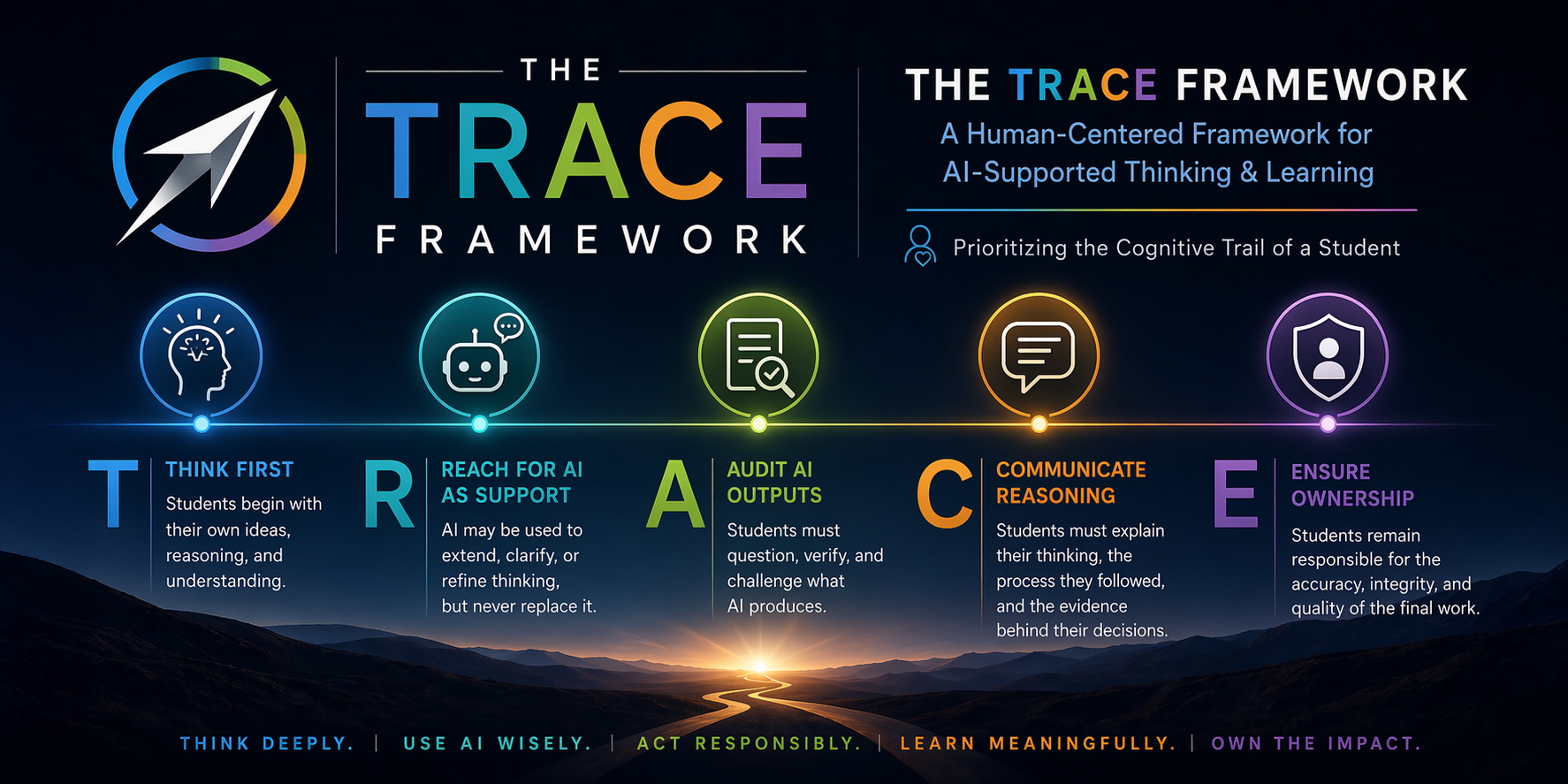
The TRACE™ Framework is a human-centered framework for AI-supported thinking and learning that prioritizes the cognitive trail of the student. Its central premise is straightforward: AI may support the learning process, but it must not erase the evidence that learning occurred.
TRACE™ provides students, educators, families, and school leaders with a shared language for responsible AI use. Students are expected to Think First, Reach for AI as Support, Audit AI Outputs, Communicate Reasoning, and Ensure Ownership.
These five expectations are not intended to become another attractive acronym that enjoys fifteen minutes of attention during professional development before retiring peacefully into a shared drive. TRACE™ is meant to shape instructional decisions, classroom routines, assessment design, student reflection, academic-integrity expectations, and the larger conversation about what learning must continue to look like when machines can produce increasingly sophisticated work.
Think First
The first expectation is that students begin with their own ideas, reasoning, questions, interpretations, and understanding. Before reaching for a machine, they must first reach inward.
Thinking first does not mean that students must complete every assignment in technological isolation. It means that they should have an intellectual starting point of their own before AI enters the process. That starting point might take the form of handwritten notes, a preliminary response, a prediction, a sketch, an outline, a mathematical attempt, a close reading, an initial design, or a conversation with a classmate.
The purpose is to give the student’s mind a chance to arrive before the machine does.
Students need opportunities to encounter uncertainty, productive struggle, incomplete understanding, revision, and even the occasional spectacularly wrong first attempt. Those experiences are not inconvenient delays on the way to learning. They are the learning. When AI appears before a student has attempted to retrieve knowledge, form an interpretation, solve a problem, or generate an original idea, it may not be supporting cognition. It may be preventing the very cognitive work the assignment was designed to develop.
The ability to recognize a strong answer depends upon having developed enough knowledge and judgment to distinguish a strong answer from a confident-looking weak one. Students cannot effectively supervise AI-generated thinking if they have not first practiced thinking for themselves.
Reach for AI as Support
Once students have begun the intellectual work, AI may be used to extend, clarify, challenge, organize, or refine their thinking. It might provide feedback on a draft, suggest questions that deserve further exploration, offer another perspective, create additional practice problems, help a student organize information, or improve accessibility.
The important distinction is between assistance and substitution.
There is a difference between using AI to receive feedback on a paragraph and asking AI to write the paragraph. There is a difference between using a tool to identify gaps in an argument and asking the tool to construct the argument. There is a difference between having AI support a student’s learning and having AI perform the learning while the student waits nearby for delivery.
AI can serve as scaffolding, but scaffolding is supposed to help build the structure. It is not supposed to become the structure.
This distinction also requires educators to be much more precise when discussing appropriate AI use. Telling students that they may “use AI responsibly” is too vague to guide meaningful behavior. Students need to understand what types of assistance are appropriate for a particular task, at what point in the process AI may be introduced, and what evidence they will need to provide concerning their own contribution.
The question should not be, “Did you use AI?” The more useful question is, “How did you use AI, and what thinking remained yours?”
Audit AI Outputs
Artificial intelligence communicates with remarkable confidence, including during the moments when it is remarkably wrong. Students must therefore learn to question, verify, test, challenge, and correct what AI produces.
They should ask where information originated, whether sources are real, whether quotations are accurate, whether evidence has been represented fairly, whether a mathematical process is valid, and whether the response actually addresses the task. They should consider what assumptions the system made, what perspectives may be missing, and whether the output reflects genuine knowledge or merely arrives wearing the costume of competence.
This is why AI literacy cannot be reduced to prompt writing. Knowing how to ask a machine for an answer may be useful. Knowing when not to trust the answer is essential.
In many discussions about AI in education, prompting has been elevated into something approaching a new academic discipline. Certainly, students should learn how to communicate effectively with emerging tools. However, sophisticated prompting without equally sophisticated auditing simply helps students generate errors with greater efficiency and more attractive formatting.
The most important AI skill may not be knowing what to ask. It may be knowing what to doubt.
Communicate Reasoning
Students should also be expected to explain their thinking, the process they followed, the decisions they made, and the evidence behind those decisions. This communication might occur through a written reflection, an annotation, a conference, an oral defense, a process journal, a revision history, a portfolio, a screencast, or a classroom discussion. The format can vary according to the task, the age of the student, and the level of AI support involved. The expectation, however, should remain consistent.
A student who submits AI-supported work should be able to explain where the work began, why AI was introduced, what the tool contributed, what the student accepted, rejected, revised, or verified, and how the final decisions connect to the content being studied.
This expectation changes the role of explanation. It is no longer an optional reflection attached to the end of an assignment after all the “real work” has been completed. Explanation becomes part of the evidence of learning itself.
Teachers frequently learn more by asking a student to explain one choice than by reading several pages of polished prose. A student’s ability to discuss an interpretation, defend a design decision, identify a weakness, or explain why an AI response was rejected reveals the quality of the thinking beneath the product.
When AI use is communicated openly, it becomes part of the learning process rather than a hidden transaction between the student and the machine.
Ensure Ownership
Finally, students must remain responsible for the accuracy, integrity, originality, and quality of the final product.
The machine does not receive the grade. It does not earn the course credit, participate in the presentation, answer follow-up questions, attend the college interview, enter the workplace, or accept responsibility when a citation turns out to be fictional. The student’s name appears on the assignment, and the student must therefore be able to stand behind it.
Ownership means more than adding a brief AI acknowledgment at the bottom of the page. It means understanding the content, defending the choices, verifying the information, revising the work, and accepting responsibility for its strengths and weaknesses. AI may contribute to the creation of the product, but the student must remain the owner of the learning.
This distinction will become increasingly important as AI-generated work becomes more difficult to identify visually. The question will not be whether a final product “looks human.” The question will be whether the student can demonstrate the knowledge, judgment, and reasoning that the product claims to represent.
What TRACE™ Looks Like in Practice
The TRACE™ Framework becomes most meaningful when it moves beyond policy language and enters the life of an actual classroom. English teacher Paul Wiley, at Staten Island Technical High School, offers a powerful example through a project connected to Nathaniel Hawthorne’s The Scarlet Letter.
In the assignment, students are asked to reclaim Hester Prynne’s scarlet “A,” transforming it from a symbol of sin and shame into a representation of her strength, resilience, and admirable qualities. Students begin through close reading. They identify adjectives Hawthorne uses to describe Hester and the scarlet letter, generate positive adjectives beginning with the letter “A,” and select a quality they believe better represents Hester’s character. Only after engaging with the text and establishing their interpretation do students design a new version of the scarlet letter.
The thinking comes first.
Students may then choose to use AI to generate the visual artwork, but that choice comes with additional intellectual responsibility. Wiley requires them to complete a HyperDoc documenting their reasoning and their interaction with the technology. Students explain which themes, symbols, and motifs from the novel inspired the design. They identify the prompts they used, connect specific visual decisions to the text, document revisions, describe what the AI failed to understand, and reflect upon both the possibilities and limitations of using AI as an artistic medium. They also provide screenshots showing how the generated image evolved.
In one student example, the group used sunlight, a dark forest, a dove carrying an olive branch, and a waffle-knit texture to represent Hester’s hope, new beginnings, generosity, and altruism. Their initial design also included a red-cross symbol, which the AI could not incorporate effectively into the letter. After reviewing the results, the students chose to remove it.
That decision is important. The initial prompt is not the learning, and the final image is not the entirety of the learning. The students’ recognition that a visual element was unsuccessful, their explanation of why it was unsuccessful, and their decision to revise the design all provide evidence of judgment.
Through this process, the teacher receives much more than an attractive AI-generated image. He receives evidence of close reading, interpretation, decision-making, revision, communication, and ownership. He can see the relationship between the students’ understanding of the novel and the visual choices they made. He can also identify where AI supported the process and where the students remained responsible for directing, evaluating, and improving the work.
The final artwork still matters, but it is no longer permitted to stand alone at the scene of the learning without witnesses.
Visibility, Not Surveillance
TRACE™ is not intended to transform teachers into digital detectives who examine every keystroke through a magnifying glass. It is not an AI sting operation, nor is it an invitation to bury students beneath seventeen reflection questions, six screenshots, three affidavits, and a notarized statement from ChatGPT.
The purpose is not surveillance. The purpose is visibility.
Teachers need sufficient evidence to understand the relationship among the student, the technology, and the final product. The amount and type of evidence should be proportionate to the assignment. A brief brainstorming activity may require nothing more than a simple acknowledgment of AI use. A major research paper, design project, or culminating assessment may appropriately include notes, drafts, source verification, prompt histories, conferences, checkpoints, or an oral defense.
The goal is not to create a procedural obstacle course that makes students regret ever learning to type. The goal is to ensure that when AI meaningfully contributes to an academic product, the student’s cognitive contribution remains visible.
This requires educators to rethink the role of process evidence. Historically, teachers may have collected outlines, drafts, annotations, and reflections as secondary materials. In an AI-supported environment, those artifacts increasingly become part of the primary evidence that a student has engaged in the learning.
From AI Detection to Better Learning Design
For the past several years, many schools have invested enormous energy in trying to detect whether AI was used. That pursuit will become increasingly unreliable, adversarial, and educationally exhausting.
Even when detection tools claim certainty, they can be wrong. When they are correct, they still reveal very little about the quality of the student’s interaction with AI. A detection score cannot tell a teacher whether the student began with an original idea, verified the information, rejected inaccurate suggestions, used feedback constructively, or understood the final product.
Detection focuses on whether AI touched the work. TRACE™ focuses on what the student thought, decided, verified, communicated, and owned.
The more sustainable strategy is not to build academic integrity entirely around catching students after the fact. It is to design learning experiences that make meaningful thinking difficult to outsource invisibly.
Teachers can require students to develop initial ideas before introducing AI. They can build checkpoints into longer assignments, gather meaningful drafts, ask students to annotate revisions, conduct brief conferences, incorporate oral components, or require students to defend important choices. They can ask students to verify AI-generated claims, compare multiple responses, identify errors, and explain why particular suggestions were accepted or rejected.
These strategies are not merely anti-cheating mechanisms. They represent stronger instructional design.
Generative AI has forced educators to confront a truth that existed long before ChatGPT: a polished final product does not always reveal how much learning occurred. By placing greater value on reasoning, reflection, conversation, revision, and demonstration, schools may ultimately create assessments that are more authentic and more human than many of the one-and-done assignments they replace.
TRACE™ Is for Adults, Too
The framework cannot become something adults prescribe to students while quietly exempting themselves. Educators and school leaders are also using AI to draft communications, analyze information, create instructional resources, plan professional learning, organize ideas, generate presentations, and improve workflows.
That use can be valuable, but the same questions should apply. Did we think first? Did we use AI to support our professional judgment or replace it? Did we audit the response? Can we explain the reasoning behind the final decision? Are we prepared to own the communication, recommendation, policy, or product that carries our name?
AI-supported leadership still requires leadership. AI-supported teaching still requires teaching. AI-supported thinking must still contain thinking.
Adults should model the intellectual transparency we expect from students. We should be willing to acknowledge when AI contributed to our work while also demonstrating that we reviewed, revised, questioned, and ultimately took responsibility for the result. Students will learn far more from seeing adults use AI thoughtfully than from hearing adults deliver warnings about technology immediately before using it to generate the warning.
The Leadership Responsibility
School leaders must move the AI conversation beyond isolated classroom rules and disconnected lists of approved and prohibited tools. Schools need a coherent instructional position that distinguishes assistance from substitution and innovation from abdication.
Professional learning should help teachers redesign learning experiences rather than simply police products. Families should understand when AI is being used, why it is being used, and what safeguards protect student learning. Students should encounter expectations that are developmentally appropriate and reasonably consistent across classrooms. Academic-integrity policies should recognize that all AI use is not equivalent, while also making clear that undisclosed substitution of machine-generated work for student thinking remains unacceptable.
AI literacy must include more than the ability to create an impressive prompt. It should include skepticism, verification, attribution, communication, ethical decision-making, and ownership.
Schools must also preserve meaningful spaces in which students continue to read, write, calculate, speak, create, debate, and solve problems without artificial assistance. Human-only learning experiences are not anti-technology. They are where students develop the knowledge and judgment required to use technology wisely.
A student cannot effectively audit an AI-generated essay without first developing the literacy required to recognize weak reasoning. A student cannot evaluate an AI-generated mathematical solution without sufficient understanding of the mathematics. A student cannot judge whether an argument is persuasive without experience constructing arguments.
We cannot outsource the very abilities students need in order to supervise the outsourcing.
That is the educational paradox now sitting squarely in front of us.
AI Supports. Humans Lead.
The goal is not to recreate a world before artificial intelligence. That world is not returning. Nor should the goal be to resist every tool simply because it changes a familiar practice.
The goal is to create something wiser than either prohibition or surrender.
We can use AI to expand possibility without allowing it to shrink human capacity. We can welcome innovation while protecting childhood, cognition, creativity, and intellectual independence. We can teach students to collaborate with powerful technologies while ensuring that they continue developing voice, judgment, curiosity, stamina, originality, communication, and responsibility.
We can modernize learning without mechanizing learners.
Doing so, however, requires a new expectation. When AI contributes meaningfully to student work, a polished product cannot be accepted as automatic proof of learning. Educators should be able to see where the student began, understand when and why AI entered the process, identify what the student questioned or changed, hear the reasoning behind important decisions, and know that the student remains responsible for the result.
We expect to see the student’s ideas, decisions, revisions, questions, verification, and evidence.
We expect to be able to see and TRACE™ the thinking. Because the purpose of education has never been merely to produce better assignments. It is to develop better thinkers.
Protect the Thinking. AI Supports. Humans Lead.

