

The AI Tool That Lets Students Put the Screen Down Without Turning the Data Off
Perhaps one of the strangest plot twists that I’ve seen in the evolution of educational technology is that artificial intelligence may ultimately drive many classrooms back to pencil and paper.
After years of pushing and integrating devices, digital assignments, online assessments, interactive platforms, one-to-one computing, and thousands upon thousands of student logins, educators are beginning to seriously reconsider the role of screens in learning. With generative AI capable of producing answers, essays, equations, explanations, and entire assignments before a student has wrestled with the first thought, many teachers are returning to handwritten work so they can once again see the student’s process, reasoning, revisions, mistakes, and intellectual fingerprints.
That instinct is understandable and in many cases, it is necessary.
But returning to paper creates an old and painfully familiar problem such as mountains of grading, delayed feedback, limited diagnostics, and valuable evidence of student thinking trapped inside stacks of worksheets, quizzes, notebooks, and assessments. Paper may protect the thinking, but it has traditionally made that thinking exceptionally difficult to analyze at scale.
Enter Frizzle (https://www.frizzle.com/), an AI-powered platform that may have discovered one of the most practical and promising middle paths in education’s current debate over technology.
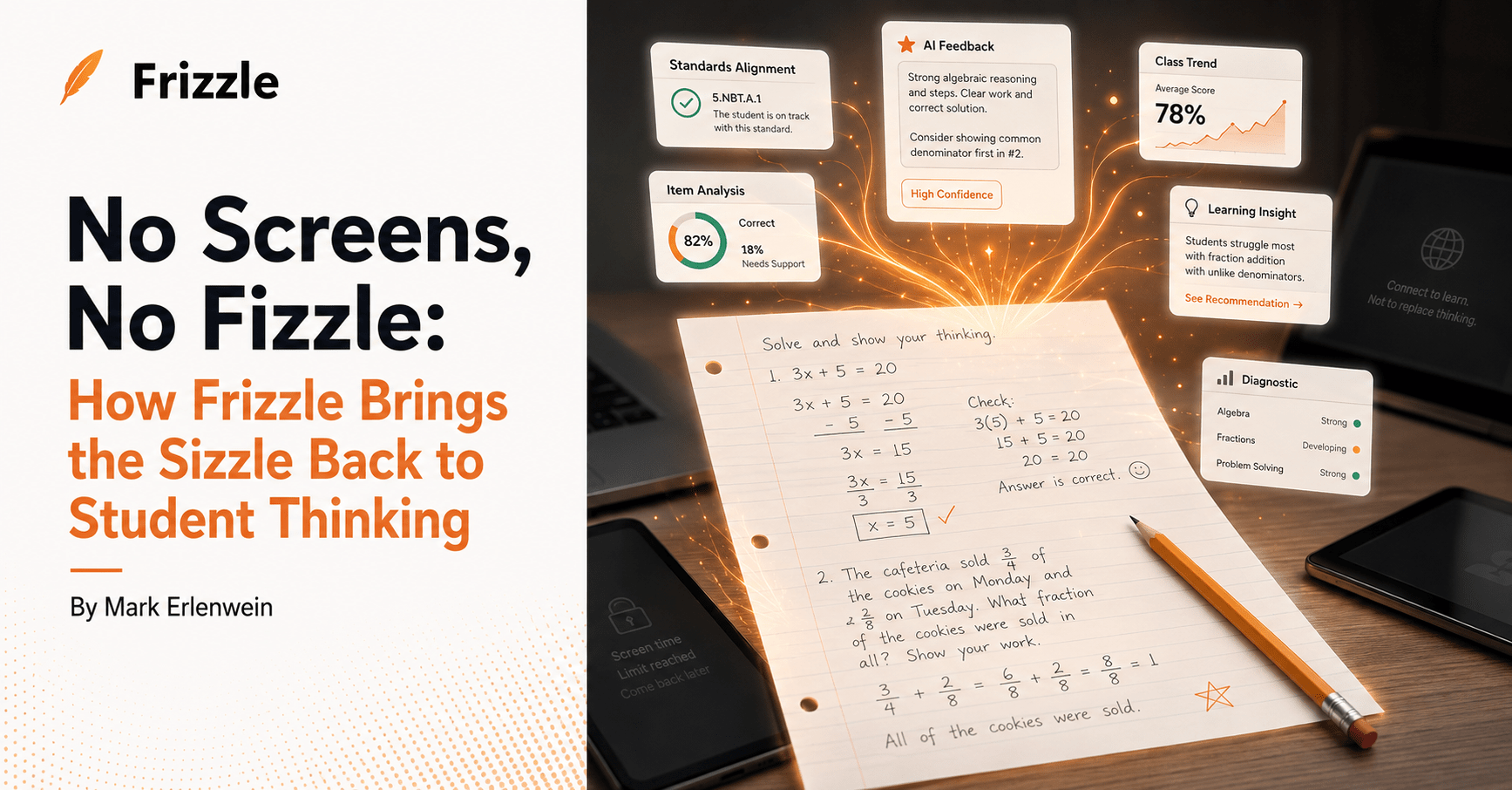
Frizzle does not require students to complete their work inside another digital platform. It does not ask teachers to abandon the assignments, curricula, or instructional routines they already value. Students can continue working with a pen or pencil on paper. The teacher can then (quickly … yes, I typed quickly) photograph or scan the completed work using a phone, document camera, or scanner. Frizzle reads the handwritten work, connects the pages to the appropriate students, and analyzes the mathematical reasoning shown throughout the response. No student tablet, login, or device rollout is required. That distinction matters enormously.
The technology does not take stage before the student has begun thinking. It enters after the student has produced something worth examining. The student still has to solve the problem, show the work, make decisions, reveal misunderstandings, correct mistakes, and leave behind a visible cognitive trail. The artificial intelligence is not being used to generate the student’s thinking. It is being used to help the teacher “trace” and more rapidly understand it.
After recently developing and writing about a framework that aims, “Trace: Protect the Thinking” … this is the kind of educational AI that gets my attention.
I recently had the opportunity to meet with Frizzle’s co-founder and CEO, Abhay Gupta, and I walked away genuinely blown away by what he and his team are building. Frizzle’s current superpower is mathematics, arguably one of the most difficult subjects for automated assessment because a final answer rarely tells the whole story. Two students can arrive at the same incorrect answer through entirely different misconceptions. Three students can arrive at the correct answer using three completely legitimate methods. Frizzle is designed to examine those different pathways, interpret the intermediate steps, recognize partial understanding, and identify where the reasoning went off course, which moves the platform well beyond an electronic answer key.
Frizzle can generate grades and student-friendly feedback, but its greater value may be in the instructional intelligence produced beneath those scores. The platform can surface common misconceptions, identify prerequisite gaps, examine performance by item and standard, and reveal patterns across individual students, classrooms, grades, schools, and potentially entire districts. Its dashboards are designed to show who is struggling, which errors are spreading, what concepts may require reteaching, and where students are demonstrating mastery or growth. Frizzle currently maps mathematical misconceptions to standards and supports Common Core, TEKS, and more than 30 state frameworks.
Imagine a mathematics teacher scanning a class set of exit tickets and learning, before planning the next lesson, that most students understood the new concept but a smaller group is carrying forward a prerequisite misconception from several grade levels earlier. Imagine a department chair seeing that the same misunderstanding is appearing across multiple classrooms. Imagine a school leader examining standards-based patterns without waiting for the next benchmark assessment, quarterly report, or postmortem data meeting. That is not simply faster grading, it is a tighter instructional feedback loop.
For years, schools have been swimming in data while frequently starving for useful information. We receive scores weeks or months after instruction has occurred, convene meetings to explain what already happened, and then attempt to reconstruct the learning decisions that might have produced the results. Frizzle offers the possibility of converting everyday student work into timely instructional evidence, while the work is still fresh enough for teachers and students to do something about it.
And, importantly, Frizzle is not presented as a robotic replacement for teacher judgment. When the system has low confidence in its interpretation of handwriting or student work, it can surface the page for human review instead of simply making a guess. Teachers remain responsible for reviewing, interpreting, and acting upon the information. According to Frizzle, the system is designed to understand multiple solution paths, provide step-level feedback, and connect its analysis to the precise place on the student’s paper where the misunderstanding occurred.
That teacher-in-the-loop design is essential. Educators should never blindly outsource professional judgment to an algorithm, especially when grades, feedback, interventions, or student opportunities may be affected. The goal should not be to remove the teacher from assessment. The goal should be to remove the repetitive burden that prevents the teacher from doing the most human and professionally consequential parts of assessment well.
There are also legitimate privacy, security, and governance questions that every school and district must examine before adopting any AI platform. Frizzle states that student work is not used to train its models, that district data remains under district control, and that the platform is FERPA and COPPA compliant and SOC 2 Type II audited. Those are meaningful commitments, although schools must still conduct their own technical, legal, contractual, and instructional reviews rather than treating any vendor’s assurances as a substitute for due diligence.
What excites me most is the broader possibility represented by Frizzle. Education does not need to choose between placing a glowing screen in front of every child for every task and retreating from technology altogether. That is a false and increasingly unhelpful narrative. We can preserve handwriting, visible problem-solving, productive struggle, authentic student work, and teacher-designed assessments while using sophisticated digital systems behind the scenes to make feedback faster, patterns clearer, and instructional decisions more precise.
Frizzle currently focuses on mathematics, but I left my conversation with Abhay equally excited about where this technology could eventually travel. Science reasoning, constructed responses, lab work, technical education, written explanations, diagrams, and other subject areas all contain valuable evidence that has historically been difficult to capture without digitizing the entire learning experience. I sincerely hope we see Frizzle’s capabilities expanded thoughtfully into additional disciplines.
That expansion should not mean allowing AI to do more of the student’s work. It should mean allowing AI to help educators see more deeply into the work students have actually done.
Frizzle is a game changer, not because it finds another reason to place students in front of computers, but because it allows powerful technology to operate in service of a fundamentally human learning process. Students can still think with their minds, write with their hands, show their reasoning, make their mistakes, and own their work. Teachers can then receive the analytical power, feedback tools, diagnostics, item analysis, standards alignment, and trend information that were previously available only through far more restrictive digital assessment environments.
Frizzle enables a beautiful equation where the student holds the pen / pencil, the teacher holds the professional judgment, while the technology handles the otherwise impossible mountain of processing between them.
That is not AI replacing education, but AI finally learning where it belongs.
 MarkErlenwein.com